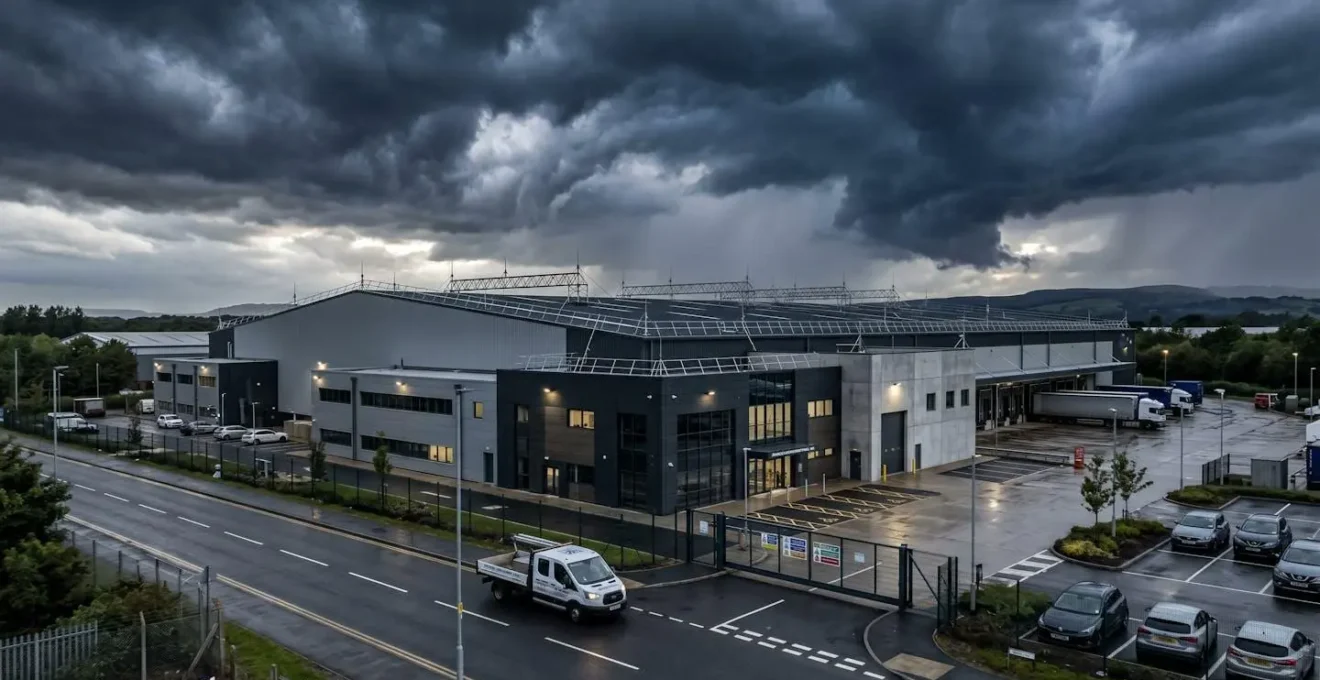
Unplanned production stoppages cost UK manufacturers dearly. A recent Censuswide survey published in October 2025 reveals that 68% of UK manufacturers experienced unplanned downtime in the past year, costing the sector up to £736 million every week. When thunderstorms threaten sites handling hazardous materials or running continuous automated processes, the stakes escalate dramatically: shut down too early and production losses mount, react too late and worker safety is compromised. Thunderstorm alert systems based on real-time lightning detection networks offer a solution by providing advance warning that enables proactive response rather than reactive crisis management. For facilities operating under COMAH regulations or managing safety-critical infrastructure, these systems have become essential tools for balancing operational continuity with regulatory compliance and workforce protection.
Your 3 priorities for thunderstorm protection:
- Assess your site’s lightning risk profile based on outdoor operations, hazardous materials handling, and automated process dependencies
- Verify IEC 62793 and COMAH compliance requirements specific to your facility classification and operating licence conditions
- Evaluate alert system capabilities including advance warning time, alert zone precision, and compliance documentation features
Why thunderstorm alerts are critical for high-risk industrial operations
The financial impact of weather-related disruption extends far beyond immediate production losses. The same Censuswide research found that 46% of UK respondents reported between 6 and 10 downtime incidents every week, with 45% stating outages last up to 12 hours. At high-risk industrial sites, the operational calculus becomes more complex: chemical plants processing hazardous materials cannot simply restart production after an emergency shutdown without extensive safety checks, pharmaceutical manufacturers face batch contamination risks if power fluctuates during critical processes, and automated production lines require careful sequencing to resume operations safely.
Regulatory frameworks recognise these challenges. The Health and Safety Executive‘s operational guidance OG44 explicitly states that a lightning strike at a major hazard installation can be an initiating event for a major accident. This positions lightning risk management not as optional insurance but as a fundamental safety obligation for sites falling under COMAH regulations, which govern facilities where dangerous substances are present in significant quantities.
Traditional approaches to weather monitoring fail these environments in three critical ways. General weather forecasts lack the spatial precision to distinguish between a storm passing two miles north of a site boundary and one tracking directly overhead. Visual observation by site personnel provides no advance warning once clouds are visible overhead, storms are typically minutes away rather than the 20 to 30 minutes needed to safely halt loading operations or secure outdoor equipment. Free public weather services cannot provide the end-of-alert confirmation that site managers need to authorise resumption of activities, creating uncertainty that extends downtime unnecessarily.
The economic argument for alert systems becomes clearer when operational realities are examined. A preventive shutdown triggered 30 minutes before a storm arrives allows lorry drivers to complete current loading operations and move vehicles to safe parking, gives maintenance teams time to secure scaffolding and cover exposed equipment, and enables control room staff to place automated processes into safe hold states rather than emergency stops. Compare this to a reactive scramble when lightning is already striking nearby: incomplete procedures, rushed decisions, and the potential for equipment damage or personnel injury.
How lightning detection systems reduce operational downtime
Lightning detection networks operate by monitoring the electromagnetic signals generated when electrical discharges occur between clouds and ground. As the IEC 62793:2020 standard defines, thunderstorm warning systems can utilise single sensors or networks of sensors such as lightning location systems to collect accurate data and provide real-time information on lightning tracks and range. Networks covering the UK and Europe typically achieve detection efficiency above 90% with location accuracy of 100 to 500 metres, far exceeding the precision of regional weather forecasts.
The operational advantage lies in how this data translates into actionable alerts. Modern systems allow facilities to define customised surveillance zones around their sites, typically ranging from 5 to 40 kilometres depending on the time needed to implement protective measures. When lightning activity enters the defined perimeter, automated alerts trigger via multiple channels: email, SMS, dedicated monitoring dashboards, and API integrations with existing SCADA or building management systems. Critically, systems also issue end-of-alert notifications once storm activity has cleared the surveillance zone, providing the documented confirmation needed to authorise resumption of outdoor work or sensitive operations.

Real-world application at safety-critical facilities demonstrates the practical value. Global chemical manufacturer LyonDellBasyll has relied on METEORAGE services for over 20 years at its French sites. According to the company’s operational protocols, all at-risk activities including lorry and wagon loading operations and site construction work are halted during alert periods, with staff moved to sheltered premises. Operations resume only after receiving the end-of-alert message. The facility also utilises post-storm lightning mapping to identify impact locations and analyse potential consequences with equipment operators, providing both an immediate safety check and long-term data for industrial building lightning protection system optimisation.
The comparison between manual monitoring methods and automated detection systems reveals the operational gap. The table below evaluates six critical criteria that determine operational effectiveness for industrial sites: response time, precision, monitoring continuity, regulatory compliance, end-of-alert confirmation, and documentation capabilities.
Data comparison based on operational capabilities as of January 2026.
| Criterion | Manual monitoring (weather forecasts + visual observation) | Automated lightning detection alerts |
|---|---|---|
| Advance warning time | 0–10 minutes (reactive response once storm visible) | 20–45 minutes (proactive alerts as storm approaches surveillance zone) |
| Location accuracy | Regional scale (10–50 km zones in public forecasts) | 100–500 metre precision (site-specific alert zones) |
| 24/7 monitoring coverage | Requires dedicated personnel monitoring forecasts and sky conditions | Fully automated monitoring with instant multi-channel alerts |
| IEC 62793 compliance | Does not meet standard requirements for ICPE sites | Designed to meet IEC 62793 specification for TWS |
| End-of-alert confirmation | No formal notification (subjective assessment of conditions) | Automated all-clear message when activity exits surveillance zone |
| Post-event documentation | No documented record of lightning activity | Timestamped impact location data for insurance and maintenance |
The documented operational benefits extend beyond immediate safety responses. Facilities using alert systems report more confident decision-making by site managers, who can justify temporary shutdowns to operations directors using objective third-party data rather than subjective weather assessments. Insurance providers increasingly recognise certified lightning detection data as valid evidence when processing damage claims, streamlining what can otherwise be contentious discussions about whether equipment failures resulted from lightning strikes or other causes.
Industries most at risk: from Seveso sites to data centers

While lightning risk affects all industrial facilities to some degree, certain sectors face disproportionate consequences from inadequate storm response protocols. The combination of outdoor operations, hazardous materials handling, and continuous process requirements creates scenarios where the cost of poor weather risk management escalates rapidly.
Sites handling hazardous substances under COMAH regulations face the most stringent requirements. The regulatory framework recognises that major accident scenarios can be initiated by lightning strikes igniting flammable materials, damaging containment systems, or disrupting safety-critical control systems. At these facilities, outdoor operations such as tanker loading, waste handling, and maintenance work must cease during electrical storm activity.
The LyonDellBasyll testimony illustrates how chemical manufacturers operationalise this requirement: predetermined shutdown procedures triggered by alerts ensure loading operations complete in controlled fashion rather than emergency abandonment, maintenance crews secure partially completed work and remove tools from hazardous areas, and control room operators place batch processes into safe hold states that prevent product loss or contamination. Post-storm lightning mapping then enables targeted inspection of areas where strikes were detected, focusing maintenance resources on equipment most likely to have sustained damage.
Critical national infrastructure facilities operate under different constraints. At HMNB Clyde naval base in Scotland, Babcock International uses thunderstorm alerts to manage power supply continuity for vessels requiring constant electrical supply. According to the company’s operational protocols, incoming alerts trigger transfer of vessels to standby electrical supplies and immediate halt of crane operations. For nuclear-powered vessels, maintaining uninterrupted power is a safety imperative rather than operational preference, and any risk to grid supplies must be eliminated proactively.
The Babcock application demonstrates how alerts provide operational decision time that manual monitoring cannot deliver. Control room staff receive sufficient advance warning to implement power transfer procedures methodically, verify backup systems are functioning correctly, and confirm all safety interlocks before the storm arrives. Real-time lightning activity tracking across the UK allows operators to monitor storm movement and anticipate duration, informing decisions about work scheduling and resource allocation.
Facilities built around continuous uptime requirements face a different challenge: even brief power fluctuations can trigger costly consequences. Data centres operating under service level agreements promising 99.99% uptime cannot afford unexpected outages, and pharmaceutical production lines running multi-day batch processes risk complete batch loss if power quality degrades during critical phases.
For these operations, lightning alerts enable preventive power management rather than reactive damage control. Advance warning allows data centre operators to verify UPS systems are fully charged, test generator auto-start sequences, and notify clients of potential service disruption windows. Manufacturing facilities can pause automated processes at safe breakpoints, ensure backup power systems are online before primary supply is threatened, and position maintenance teams to respond immediately if equipment protection systems activate.
Implementing thunderstorm alert systems: compliance and best practices
Successful deployment of thunderstorm warning systems extends beyond purchasing a service subscription. Effective implementation requires integration with existing emergency procedures, staff training on response protocols, and documentation systems that satisfy both regulatory and insurance requirements.
The international standard IEC 62793:2020 establishes the framework for thunderstorm warning systems used to implement lightning hazard preventive measures. The standard specifies that systems must provide accurate real-time information on lightning tracks and range, utilising either single sensors or networks of sensors to achieve the required detection performance.
For industrial sites, compliance begins with a site-specific risk assessment following the methodology outlined in IEC 62305-2. This analysis considers lightning flash density for the geographic location, the presence of hazardous materials or processes, the exposure of outdoor operations, and the potential consequences of lightning-initiated accidents. The assessment determines the required detection range and alert zone configuration appropriate to the facility’s risk profile.
Sites classified under ICPE regulations (Installations Classées pour la Protection de l’Environnement) in France or equivalent COMAH frameworks in the UK must demonstrate that their lightning risk management approach meets the ALARP principle: risk reduced to As Low As Reasonably Practicable. Documented use of certified detection systems and formal response protocols provides the evidence base for regulatory compliance and demonstrates due diligence in the event of incidents.
Alert systems deliver value only when integrated into actionable emergency protocols. Effective implementation requires defining clear responsibilities for who monitors alerts, who authorises protective actions, and who confirms safe resumption of operations. Many facilities designate control room operators as primary alert recipients with automatic escalation to HSE managers if response actions are not acknowledged within defined timeframes.
Standard operating procedures must specify exactly which activities cease during alert periods. For outdoor operations, this typically includes all work at height, crane operations, loading and unloading of hazardous materials, and maintenance activities involving exposed electrical systems. Indoor operations may continue unless they involve safety-critical systems vulnerable to power fluctuations or processes that cannot be safely paused.
Training programmes should ensure all staff understand alert messages, recognise their personal responsibilities during warnings, and know the signals indicating safe resumption. Regular drills test whether procedures work as intended and identify gaps before real events expose them. This integration work connects directly with broader elements of an emergency planning strategy that encompass multiple hazard scenarios beyond lightning risk alone.
Evaluating thunderstorm alert services requires assessment across multiple dimensions beyond simple subscription cost. Detection network coverage must encompass your facility location with sufficient sensor density to achieve the accuracy and reliability your operations require. Systems should provide configurable alert zones that match your operational response times: if your procedures require 30 minutes to implement protective measures, the surveillance perimeter must be sized to provide that advance warning given typical storm movement speeds.
Technical support availability matters particularly for 24/7 operations. Facilities running continuous processes need confidence that alert system issues will be addressed immediately regardless of when they occur, making round-the-clock technical support a practical necessity rather than premium feature. Documentation capabilities also warrant attention, especially for COMAH sites where regulatory compliance in energy sectors and other high-risk industries demands comprehensive audit trails of safety system performance.
ROI calculations should compare system costs against the value of production protected and insurance benefits obtained. For a facility where unplanned downtime costs £15,000 per hour and historical data shows 4 to 6 weather-related shutdowns annually, an alert system enabling 40% downtime reduction through better-timed preventive measures delivers quantifiable savings. Add reduced insurance premiums from demonstrable risk management and faster claims processing enabled by documented lightning strike data, and business cases become compelling even for smaller operations.
IEC 62793 compliance: implementation checklist
- Complete site-specific lightning risk assessment using IEC 62305 methodology to determine required protection level
- Define alert surveillance zones based on site layout, critical operations, and minimum time required to implement protective measures
- Integrate alerts with emergency response procedures and document shutdown protocols for each operation type
- Train operational staff, control room operators, and HSE personnel on alert interpretation and required response actions
- Establish documentation system for compliance records, alert logs, and post-event reports for regulatory and insurance purposes
- Test alert system integration with existing SCADA, communication systems, and verify backup alert delivery channels function correctly
Your questions about thunderstorm alert systems
How accurate are lightning detection networks?
Modern lightning detection networks covering the UK and Europe typically achieve detection efficiency above 90%, with location accuracy ranging from 100 to 500 metres depending on network density and sensor proximity. This precision far exceeds general weather forecasts, which operate at regional scales of 10 to 50 kilometres and cannot distinguish whether a storm will pass directly over your facility or several miles away. For industrial sites requiring site-specific protection decisions, this accuracy difference is operationally critical.
What advance warning time can we expect from alert systems?
Typical advance warning ranges from 20 to 45 minutes before a storm reaches your monitored site, depending on storm movement speed and the size of your configured alert zone. Facilities requiring longer preparation times (such as chemical plants with complex shutdown procedures) can define larger surveillance perimeters of 30 to 40 kilometres, whilst operations needing less preparation may use tighter 10 to 15 kilometre zones. The system tracks storm movement in real-time, allowing you to monitor progression and refine timing estimates as conditions develop.
How do thunderstorm alerts integrate with existing SCADA systems?
Professional alert services offer multiple integration methods including API connections, webhook triggers, email notifications, SMS alerts, and direct dashboard access via web browsers. SCADA integration typically uses API calls that pull current alert status or webhook notifications that push alert state changes to your control systems in real-time. This enables automated responses such as placing equipment into safe modes, activating backup power systems, or generating operator alerts on existing monitoring screens. No on-site hardware installation is required for browser-based access, whilst API integrations require standard network connectivity and appropriate firewall configurations.
What training is required for operational staff?
Staff training should cover three essential areas: understanding what alert messages mean (including alert onset, active warning period, and end-of-alert signals), knowing their specific role in response procedures (which activities they must cease, where to relocate, what equipment to secure), and recognising authorisation signals for safe resumption of operations. Control room operators require additional training on monitoring storm progression via tracking dashboards and escalation procedures if response actions are not acknowledged. Most facilities incorporate thunderstorm response into existing emergency drill programmes, testing procedures 2 to 4 times annually to maintain competency and identify procedural gaps.
How do we document lightning damage for insurance claims?
Lightning detection systems provide timestamped, geolocated records of strikes detected on or near your facility during specific time periods. When equipment failure occurs potentially due to lightning, you can request strike data for the relevant timeframe showing exact impact locations, strike intensity, and precise timing. This objective third-party documentation proves whether lightning activity occurred in proximity to damaged equipment and correlates failure timing with detected strikes. Insurers increasingly recognise certified lightning detection data as credible evidence, streamlining claims processing that might otherwise involve lengthy technical investigations and disputed causation arguments. DEHN UK, a specialist in electrical engineering and lightning protection, relies on certified lightning detection services for accurate site-specific flash density and historical activity data specifically to support risk assessments and insurance documentation for high-risk and critical national infrastructure sites.
For your next steps: The most significant error facilities make is treating thunderstorm risk management as an insurance checklist exercise rather than an operational continuity tool. Sites that view alert systems solely through a compliance lens miss the production value these systems deliver through better-timed preventive measures.
Rather than conclude, consider this strategic question for your operations: what is the current cost of uncertainty in your weather-related shutdown decisions, and how would documented advance warning change the confidence with which your site managers balance safety obligations against production targets?
Safety implementation guidelines
- This guide provides general information on thunderstorm alert systems and does not replace a site-specific risk assessment conducted by certified safety professionals.
- Regulatory requirements mentioned (IEC standards, COMAH) are current as of 2026 but should be verified with official sources for your specific site classification.
- Each industrial facility has unique operational constraints, hazard profiles, and protection requirements that necessitate tailored safety solutions.
Identified risks if guidance is applied without professional consultation:
- Risk of inadequate protection if alert system is not properly integrated with site-specific emergency response protocols
- Risk of non-compliance if IEC 62793 requirements are not fully implemented for your site classification
- Risk of false sense of security if staff are not properly trained to interpret and respond to thunderstorm alerts
For safety-critical decisions, consult an HSE-accredited safety consultant or certified lightning protection expert (IEC-compliant assessor).